I. Archiving the Past: Personal Letters as Living History
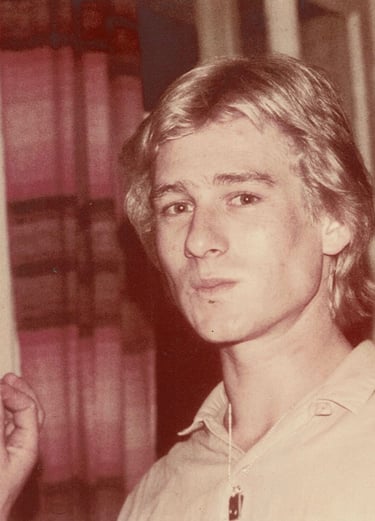
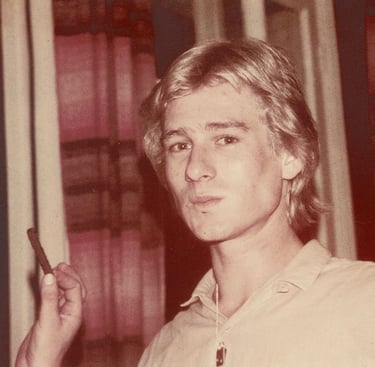
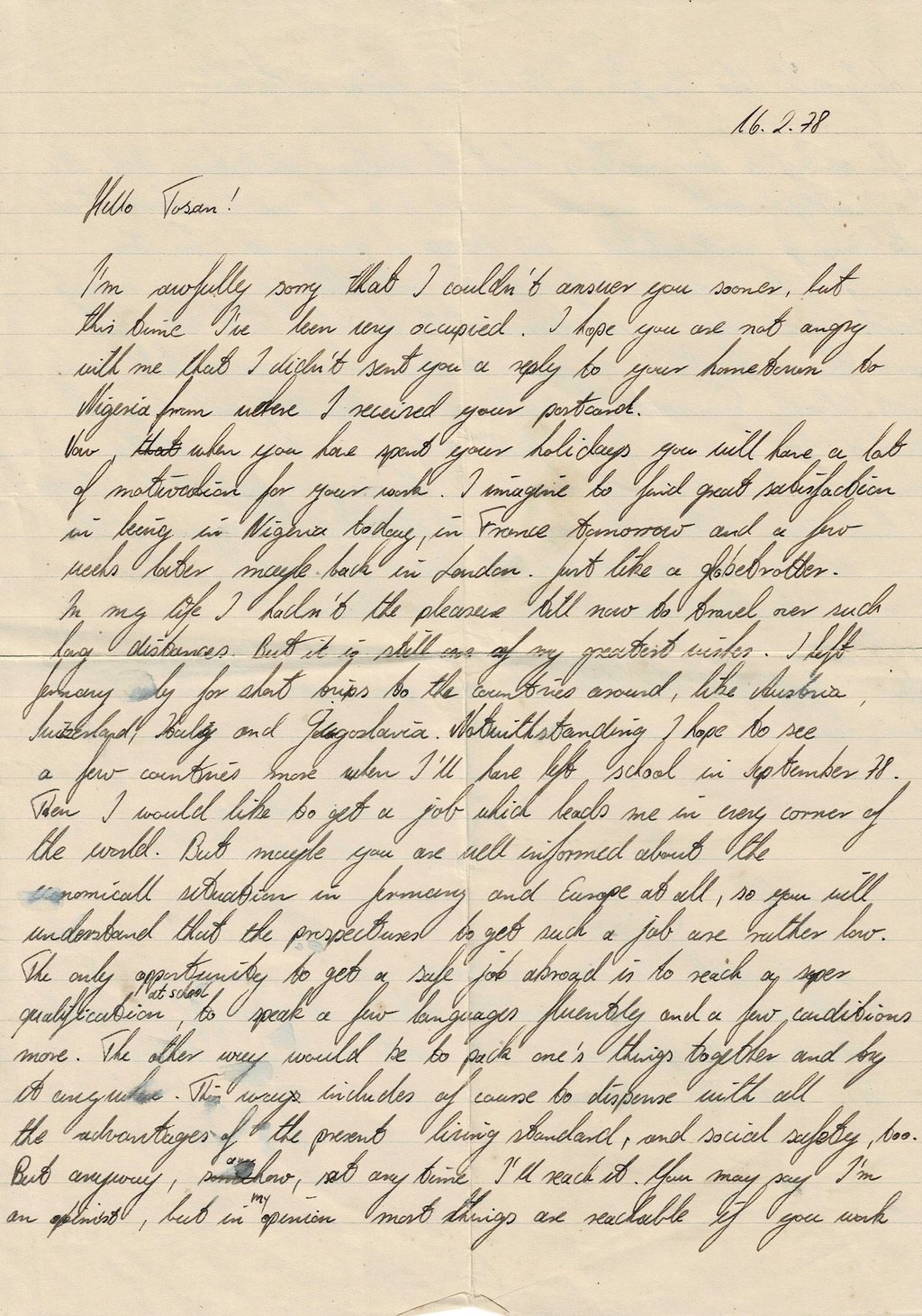
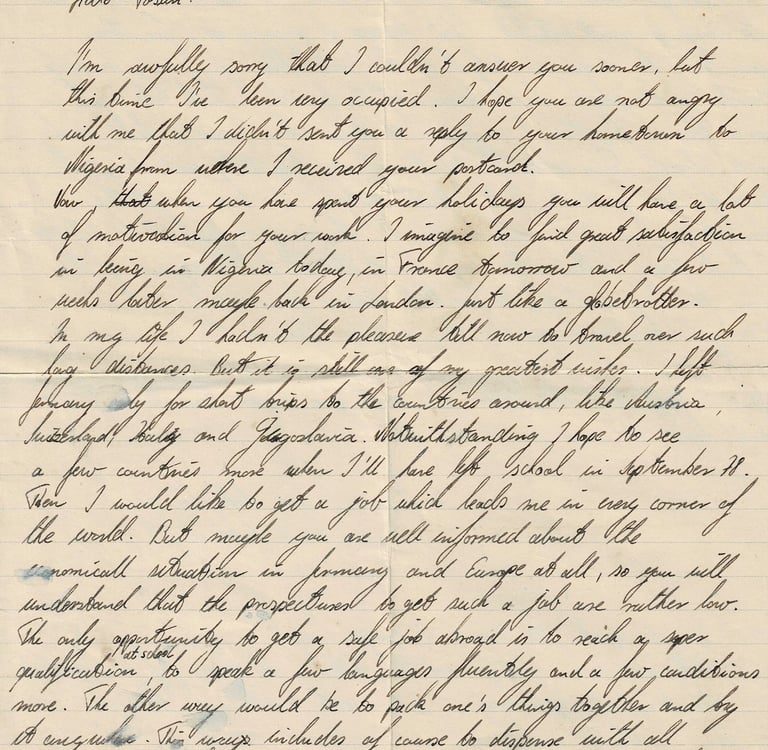
The core of Josef’s Dream is the personal correspondence between my mother and Josef Span. The first letter I encountered from Josef was dated February 16th, 1978, where he shared his admiration for my mother’s ability to move between countries with the ease of a “globetrotter.” He wrote: “I imagine to find great satisfaction in being in Nigeria today, in France tomorrow, and a few weeks later maybe back in London” (Span, 1978).
Originally from Reutlingen, Germany, Josef dreamed of breaking free from the confines of post-World War II Europe. At the time, the economic situation and political instability made his aspirations difficult to realize. His letters were filled with longing for freedom, mobility, and a better life outside of the confines of his home country. These exchanges speak not only of physical travel but of an emotional journey as well—of dreams deferred, of hope, and of the desire to escape circumstances that were beyond his control.
Despite his ambitions, Josef faced significant barriers. In his letter, he spoke of the two paths available to him: one was to seek an advanced education, master foreign languages, and secure a job abroad in an international context; the other was to leave his home country altogether, abandoning the relative security of post-war Germany for an uncertain life in a foreign land. In his words:
“I would like to get a job which leads me in every corner of the world. But may be you are well informed about the economical situation in Germany and Europe at all, so you will understand that the prospectuses to get such a job are rather low. The only opportunity to get a safe job abroad is to reach a super qualification at school, to speak a few languages fluently, and a few conditions more. The other would be to pack one’s things together and try it anywhere. This way includes of course to dispense with all the advantages of the present living standard, and social safety too. But anyway, anyhow, at any time I’ll reach it.” (Span, 1978).
His yearning for movement—the idea of traveling across continents and transcending national borders— reflects a universal human desire and longing to transcend one’s circumstances, both physically and emotionally, and resonates deeply with my own artistic practice. Memory, like travel, is not fixed but is constantly shifting, transforming, and evolving. Moreover, the act of writing itself is a form of movement—a means of navigating and negotiating the distance between two people and between distant places and times.
A. Language as a Gateway to Movement
Another central theme of Josef’s letters is his deep belief in the importance of language learning as a means of achieving his dreams. This desire to speak multiple languages—French, English, and others—was not just a practical need but a vital aspect of his vision for the future. It was in pursuit of this goal that he enrolled in a French language course at the Centre International d’Études Françaises (CIDEF) in Angers in 1980, where he would meet my mother. Although they had been pen pals since 1978, their face-to-face meeting in Angers marked a significant chapter in their friendship. Josef’s decision to learn French was tied not only to his immediate need for practical language skills but also to his desire for connection and his ongoing pursuit of a better life abroad. My mother seemed to echo these beliefs as recorded in a university application letter she wrote in 1982:
“In a modern world where interactions with other nations and nationals is inevitable, the knowledge of international languages cannot be over emphasized” (Edodo, 1982)
B. The Physical and Emotional Journey
After his time in Angers, Josef continued his language studies in Levallois-Perret in 1981. These educational experiences, coupled with his increasing fluency in multiple languages, helped him eventually secure a new life in the United States. The correspondence between Josef and my mother continued until 1983, when their letters stopped after his move to the U.S. Although their direct communication ceased, the impact of their connection—and Josef’s dreams of freedom, movement, and a better life—remained deeply embedded in my mother’s memory.
The longing and nostalgia for their time together in France became more pronounced, especially for my mother, who often reflects on the loss of their correspondence and the connection that once existed. Through the re-reading of his letters, she experiences a deep yearning for a time and place that has become increasingly distant, almost like a dream. This sense of loss, of distance between what was and what is, has become part of the narrative of their friendship.
In my own work, I seek to capture this tension between presence and absence. Like the jute fabric I use in my art, memories are woven from layers of emotion, time, and experience. The letters themselves, often brittle, the ink fading with time, serve as both a literal and metaphorical map to the past, a map that traces not just physical distance but emotional terrain. In the same way that Josef dreamed of escaping the confines of his life to travel the world, my mother’s nostalgia for their time together becomes a form of travel—a journey not across geography, but through memory.
Additionally, I use references to American travel and imagery to evoke the sense of finality that came with Josef’s relocation. Slogans from travel advertisements, such as “Tour the United States” and “See the USA...vacation land of the world!”—found on the letter envelopes—speak to the cultural optimism and promises of a new life that Josef sought in America. The inclusion of Pan Am Airways tickets and other travel-related symbols further underscores the theme of journeying, linking the personal aspirations of Josef’s past to the broader cultural context of 20th-century America, and the popularisation of the American Dream.
These elements help to create a rich visual language in the works, connecting Josef’s personal journey with the collective symbols of migration, aspiration, and freedom that permeate the American Dream. By layering these travel references with the tactile medium of fabric, I aim to trace the emotional contours of the journey that Josef embarked upon, marking the transition from his dreams of travel to the reality of his relocation and the eventual silence that followed their correspondence.
Yoma Emore
Email:
emoreyoma2016@gmail.com